
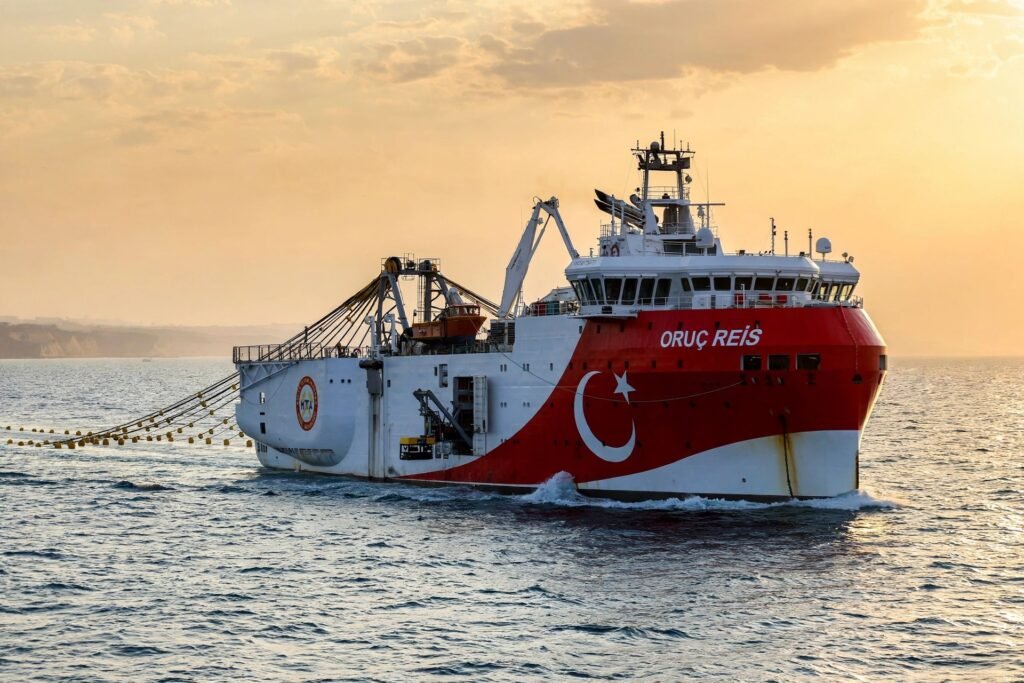
Turkish ship Oruc Reis begins offshore oil and gas survey off Pakistan’s coast
A Turkish seismic research vessel has arrived in Karachi to begin the first serious hunt for offshore oil and gas in Pakistani waters in about 20 years, in a project both countries describe as a new era in their energy partnership.
The Oruc Reis, Türkiye’s flagship survey ship, was welcomed at Karachi Port on Friday at a ceremony attended by Turkish Energy Minister Alparslan Bayraktar, Deputy Prime Minister and Foreign Minister Ishaq Dar, and Petroleum Minister Ali Pervaiz Malik. Prime Minister Shehbaz Sharif hosted a dinner for the Turkish delegation the same evening, thanking Turkish President Recep Tayyip Erdogan for sending the vessel and its full cooperation.
What the ship will do
The Oruc Reis will spend about two months mapping the seabed off Pakistan’s coast. The first phase, the Marjan 3D Seismic Project in the Indus-C Block off Karachi, will collect high-resolution 3D seismic data across about 670 square kilometres over roughly 50 days. The ship will then move west to the Makran basin off Balochistan, where it will gather 2D seismic data along 2,353 kilometres of survey lines over about 25 days.
Seismic surveys work by sending sound waves into the seabed and reading the echoes, building a picture of the rock structures below. They do not prove that oil or gas is there — only drilling can do that — but they tell explorers where it is worth drilling. Dar was careful to make that point at the ceremony, saying the survey would deepen understanding of the geological structures beneath the seabed, while cautioning that it did not guarantee commercially viable discoveries.
Who is involved — and what it could be worth
The project runs under energy agreements signed between Pakistan and Türkiye in December 2025, covering three offshore and two onshore blocks. Turkish Petroleum holds a 25 percent stake and the technical operatorship of the Indus-C block, alongside Pakistan Petroleum Limited with 35 percent, the Oil and Gas Development Company with 20 percent and Mari Energies with 20 percent. The partners have committed roughly $80 million in initial exploration spending, a figure that could grow towards $1 billion if the seismic results justify deep-water drilling. Turkish officials say drilling could begin in 2027 if the survey identifies promising sites.
The mission is the Oruc Reis’s second overseas assignment, after a survey off Somalia in which it mapped 4,464 square kilometres of seabed. The 87-metre vessel, built in Türkiye in 2017 and operated by Turkish Petroleum, sailed from the Turkish port of Tasucu on 30 October and reached Karachi after a 19-day voyage.
Why Pakistan is looking offshore now
Pakistan has not carried out serious offshore exploration for two decades, and it imports most of the fuel it uses — a bill that strains the country’s finances every year. In January 2025 the government launched its first offshore bidding round in 18 years, offering 40 blocks, and a basin evaluation by the US petroleum consultancy DeGolyer and MacNaughton pointed to untapped potential along the coast.
At the Karachi ceremony, Dar also said Pakistan’s natural resources were worth $8–10 trillion at “the most conservative estimate” — a striking figure, but one that rests on early estimates rather than proven reserves, and the real test will be what the survey actually finds. Bayraktar said the ship’s arrival marked the beginning of a new phase in energy cooperation, adding that Türkiye was committed to using its technical expertise and engineering capability for Pakistan’s benefit.
What happens next
Over the next two and a half months, Turkish geophysicists and Pakistani energy partners will work through the two survey phases, then study the data to pick the most promising sites. If the results support it, drilling is targeted for 2027 — the moment when Pakistan will find out whether the seabed off its coast holds the energy wealth both governments are hoping for.
اردو خلاصہ
ترکی کا زلزلہ پیما تحقیقی جہاز اورچ رئیس کراچی بندرگاہ پہنچ گیا ہے اور پاکستان کے سمندری علاقوں میں تیل و گیس کی تلاش کے لیے تقریباً دو ماہ کا سروے شروع کرے گا۔ پہلے مرحلے میں کراچی کے قریب انڈس سی بلاک میں 670 مربع کلومیٹر کا تھری ڈی سروے ہوگا، پھر مکران کے علاقے میں سروے کیا جائے گا۔ اگر سروے کے نتائج حوصلہ افزا ہوئے تو 2027 میں ڈرلنگ شروع ہو سکتی ہے۔ نائب وزیراعظم اسحاق ڈار نے خبردار کیا کہ سروے کا مطلب تجارتی ذخائر کی ضمانت نہیں۔
Sources: Dawn, 21 Nov 2026; The News, 21 Nov 2026; Türkiye Ministry of Energy and Natural Resources, 20 Nov 2026; PKRevenue, 20 Nov 2026.
Do you think Pakistan’s offshore waters really hold oil and gas worth drilling for — or is this another promise that will fade away? Tell us what you think.