
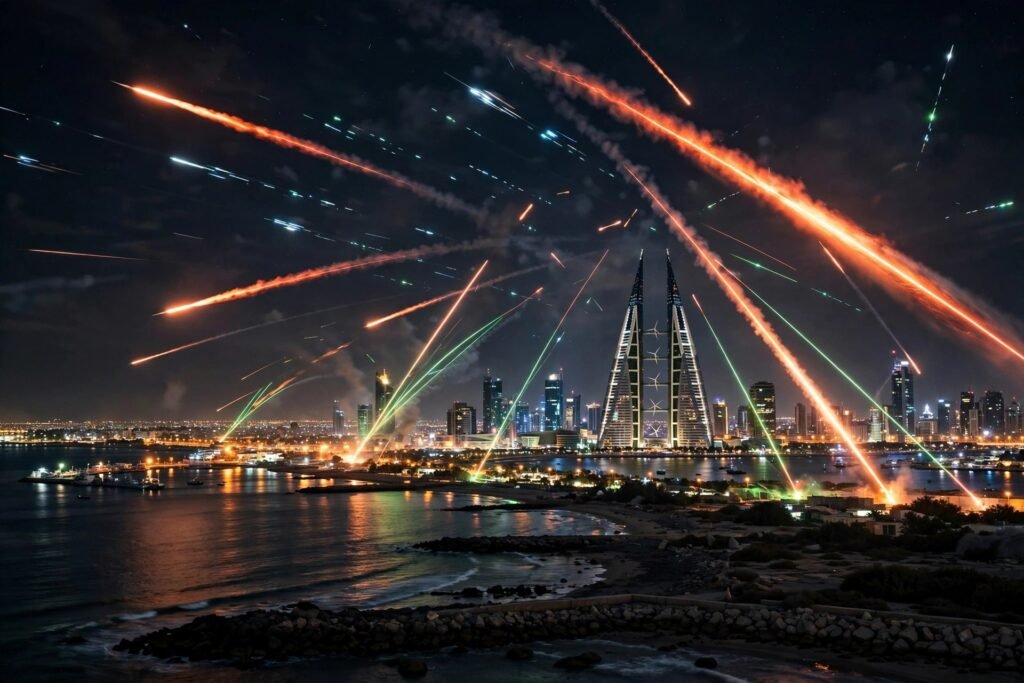
Iran strikes US bases in Bahrain with missiles and drones, Bahrain says factory hit
Iran’s Revolutionary Guards said on Saturday night they had launched missile and drone strikes on American military positions in Bahrain, in the sharpest escalation yet of the open confrontation between Tehran and Washington in the Gulf.
The Islamic Revolutionary Guard Corps, known as the IRGC, said its Aerospace Force had carried out a combined missile-and-drone attack on United States positions at the Al-Riffa and Awali bases in Bahrain. In a statement carried by Iranian state media, the Guards said the attack had hit the radars of two American Patriot air defence systems, and described it as retaliation for what it called continued aggression and repeated violations of Iranian airspace.
Bahrain, home to the headquarters of the US Navy’s Fifth Fleet, told a very different story about what the night’s explosions had actually struck. The kingdom’s interior ministry said a civilian industrial facility had been targeted in what it called a heinous Iranian attack, and that a fire had broken out at the site. Civil defence teams worked to bring the blaze under control, and the ministry said there were no injuries, only material damage. Bahrain’s Defence Force said its air defences had intercepted a number of Iranian aerial attacks, and that falling debris from the interceptions had caused damage on the ground, but no casualties.
Two accounts that do not match
The gap between the two accounts is striking. Iran says it destroyed American military hardware. Bahrain says the only confirmed damage is to a civilian site and to property hit by falling debris. The United States military did not immediately respond to requests for comment on the Guards’ claims, so by Sunday morning there was no independent confirmation that any American equipment had been damaged.
Even the Iranian accounts disagree with each other about the targets. The IRGC’s official statement named the Al-Riffa and Awali Sakhir bases, while the semi-official Fars news agency reported earlier that the Shaikh Isa and Al Juffair bases had been attacked. That discrepancy has not been explained.
What is clear is that residents across Bahrain heard the attack. Sirens sounded in several areas, and the interior ministry twice urged people to move to the nearest safe location as the strikes came in. Videos shared locally showed smoke rising from a fire at an unidentified site.
Why Iran says it struck
The Guards said the operation was a response to two American drones — an MQ-1 Predator and an MQ-9 Reaper — that they said had violated Iranian airspace earlier on Saturday, and to an attack on a radar installation on Iran’s Hengam Island in the Gulf. Iranian state television released footage it said showed the two drones being shot down over the Strait of Hormuz, and the Guards claimed to have destroyed dozens of American drones over the course of the year — claims Washington has not confirmed.
The Guards warned that Iranian airspace was a red line, and that any further violation would meet what it called a harsh and decisive response. Hours before the Bahrain strikes, the US military’s Central Command had denied an Iranian claim that a surface-to-air missile had damaged an American F-16 fighter jet on Friday evening. Explosions were also reported on Saturday night in Sirik County on Iran’s southern coast, though it was not clear what caused them.
Why Bahrain matters
Bahrain sits less than 300 kilometres from Iran’s southern coast, and the American naval base there is one of the most important military installations in the Gulf. The island kingdom has been drawn repeatedly into the confrontation: Al Jazeera reported that it had been hit by three drone attacks in recent days after several weeks of calm.
The wider conflict has been running openly since the United States and Israel attacked Iran on 28 February, and it has centred on the Strait of Hormuz, the narrow waterway through which a large share of the world’s seaborne oil passes. Iran has tightened its grip on the strait, the United States has moved to block Iranian oil tankers, and both sides have traded strikes and claims for months.
What happens next
The immediate question is whether Washington answers the Bahrain strikes, and whether the damage claims from either side are confirmed. Iran has also put forward a two-day plan to cease hostilities and reopen the Strait of Hormuz, which its deputy foreign minister said on Saturday was still on the table — a reminder that even as the missiles fly, both sides are still talking about a way out. For now, though, the Gulf is braced for whatever comes next, and shipping, oil markets and governments across the region will be watching every move.
ایران کا بحرین میں امریکی اڈوں پر میزائل اور ڈرون حملہ
ایران کی انقلابی گارڈز نے ہفتے کی رات دعویٰ کیا ہے کہ اس کی فضائی فورس نے بحرین میں امریکی فوجی ٹھکانوں پر میزائل اور ڈرون حملے کیے اور دو پیٹریاٹ دفاعی نظاموں کے ریڈار نشانہ بنائے۔ ایران کا کہنا ہے کہ یہ حملہ امریکی ڈرونز کی جانب سے ایرانی فضائی حدود کی خلاف ورزی کا جواب تھا۔ دوسری جانب بحرین کا کہنا ہے کہ ایک شہری صنعتی مقام پر آگ لگی، کوئی زخمی نہیں ہوا، اور بحرینی فضائی دفاع نے کئی حملے ناکام بنائے۔ امریکہ نے اب تک ایرانی دعوے پر کوئی تبصرہ نہیں کیا۔ بحرین امریکی بحریہ کے پانچویں بیڑے کا ہیڈکوارٹر ہے۔
Sources: Reuters, 21 Nov 2026; Xinhua, 22 Nov 2026; Al Jazeera, 22 Nov 2026; IRNA / Sepah News, 21 Nov 2026; Bahrain Ministry of Interior and Bahrain Defence Force statements, 21 Nov 2026.
Iran says it hit American radars in Bahrain, Bahrain says only a civilian site burned — whose account do you believe, and what should happen next in the Gulf? Tell us what you think.